Ancient Egyptian Inscription Discovered in Jordan for the First Time
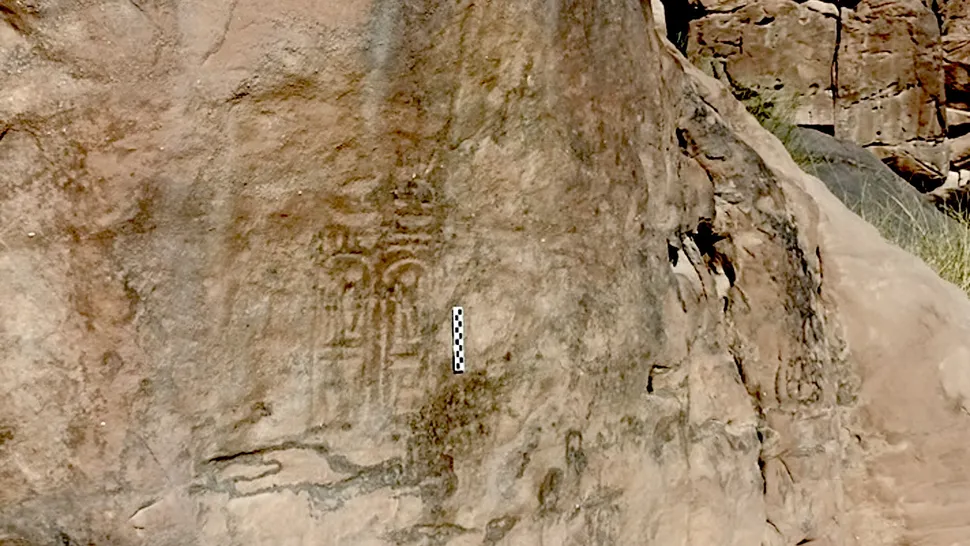
A Royal Cartouche of Ramses III in Wadi Rum
Photo: Jordan’s Ministry of Tourism and Antiquities
On April 19, 2025, Jordan’s Ministry of Tourism and Antiquities announced the discovery of the first ancient Egyptian inscription in the history of Jordanian archaeology. Lina Annab, Jordan’s Minister of Tourism and Antiquities, noted that Jordan is an ‘open library’, as its territory contains numerous rock inscriptions in various languages. However, until now, no Egyptian hieroglyphs had been encountered among the Nabataean, Ammonite, and Arabic inscriptions, which underlines the exceptional value of this find.
The inscription was discovered east of the port city of Aqaba in Wadi Rum, which is known for its petroglyphs, epigraphy, and archaeological monuments. Egyptian archaeologist Zahi Hawass, who had been invited by Jordanian authorities, stated that the inscription is a royal cartouche of Pharaoh Ramses III of the Twenties Dynasty (1186–1155 BC), consisting of the pharaoh’s family and throne names. The monument serves as evidence of military campaigns during the reign of Ramses III, who sought to control the copper mines in the southern region of what is now Jordan. Cartouches of Egyptian pharaohs were previously recorded at the Tayma oasis in present-day Saudi Arabia and on the Egypt-Israel border at Temilat Radadi. Thus, the cartouche from Wadi Rum joins a group of epigraphic monuments symbolising Egyptian influence in Arabia and the Levant during the reign of Egypt’s Twenties Dynasty.
Elena G. Tolmacheva, an Oikoumene’s Editorial Board Member and a Researcher at Moscow State University Research Institute and Museum of Anthropology, commented on the news as follows: “The era of Ramses III is known for a large-scale confrontation between the Egyptians and the ‘Sea Peoples’, a powerful confederation of tribes whose invasion brought an end to Bronze Age civilisation. Ramses III managed to repel the foreign invasion and conduct several successful campaigns in Syria and Palestine. The discovered inscription may indicate an Egyptian penetration into the Arabian Peninsula that was broader than previously known. We await the scholarly publication of the text.”