Felsina
Publication date: 18.05.2025
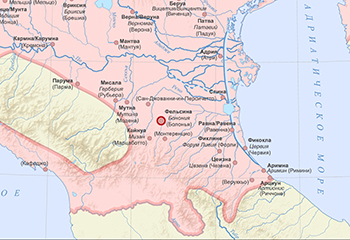
- Alternative name:
- Felzna, Velzna
- Region:
- Western Europe
- Timespan:
- 9th century BC — 189 AD.
- Coordinates:
- 44.5
11.35
FELSINA — a city in Padanian Etruria on the site of modern Bologna, Italy. Felsina is located in the valley of two large rivers, the Reno and Savena. Two smaller rivers, the Ravone and Aposa, flank the settlement.


Fig. 1. Map of Padanian Etruria

Fig. 2. Reconstruction of a Burial
In: Donati, A., and G. Sassatelli (eds.). Storia di Bologna. Vol. I. Bologna nell'antichità. Bologna: Bononia University Press, 2005, p. 169
.jpg)
Fig. 3. Grave Goods from the Tomb Benacci Caprara 39
Drawing by O. Kalinina ©. Adapted from: URL: https://www.museibologna.it/archeologico/catalogo/percorso/&id=13&oggetto=58&set=0 (accessed: 01.11.2024)

Fig. 4. Stela from Rubiera
In: Zamboni, L. Sepolture arcaiche della pianure Emiliana. Il rioconoscimento di una società di frontiera.Roma: Edizioni Quasar, 2018. Publications — Reditus. Riflessioni di Archeologia, 1. pp. 37–38

Fig. 5. Statuette of Apollo Excavated at AcropolisDrawing by O. Kalinina ©. Adapted from: URL: https://www.museibologna.it/archeologico/catalogo/percorso/&id=46&oggetto=109&set=0 (accessed: 01.11.2024)
FELSINA — a city in Padanian Etruria on the site of modern Bologna, Italy. Felsina is located in the valley of two large rivers, the Reno and Savena. Two smaller rivers, the Ravone and Aposa, which flow from the slopes of the Northern Apennines, flank the settlement.
Etymology
Felsina is a Latinised name of the city; Etruscan one is yet to be identified. Based on the demonyms known from epigraphy, it has been reconstructed as Felsina or Felzna, which, typologically, might be close to Velzna, the Etruscan name for Volsinii.
Written Sources
Servius has preserved traces of two plausible mythological versions for the foundation of Felsina (Serv. Aen. X, 198). One, likely dating back to Aulus Caecina and Verrius Flaccus, identifies Tarchon, whose name is thought to be related to the heroic Roman gens Tarquinia, as a founder of the cities of Padanian Etruria. The second directly attributes Felsina’s foundation to Ocnus, the son or brother of the founding king of Perusia Aulestes.
Some researchers explain the existence of two theories by different waves of migrations to the Padan region. The earlier one, from 10th to 9th century BC, created the first Villanovan culture settlements. The later one, in the second half of the 8th century BC, led to the growth of population and increased number of cities in this area [Donati, Sassatelli 2005: 122] (Fig. 1).
Pliny the Elder indicated Felsina’s great importance for Padanian Etruria: “located in the heart of the colony of Bononia, it was called Felsina when it was the first city of Etruria...” (Plin. HN. III, 115: intus coloniae Bononia, Felsina vocitata tum cum princeps Etruriae esset). Combined with Livy’s accounts about twelve cities in Padanian Etruria (Central Etruria) forming a union, researchers in the beginning of the 20th century concluded that Felsina had been the political capital of the region (Liv. V, 33, 10). Currently, the most widespread opinion is that of G. Colonna [Colonna 1999], who holds that Pliny’s definition of ‘princeps’ indicates only the age of Felsina, not its importance.
The city is mentioned by Livy in his account of plundering of Boii and Ligurians’ lands by the consuls Lucius Furius Purpureo and Marcus Claudius Marcellus in 196 BC, under the name of Felsina (Liv. XXX, 37, 3–4). However, the name of the Roman colony established in 189 BC on this site is Bononia, which has Celtic connotations.
Thus, reconstructing the history of Padanian Etruria in general, and Felsina as an important centre, one has to rely more on archaeological data.
Villanovan Culture and the ‘Orientalising’ Period (9th to mid-6th Century BC)
According to Archaeological Data
After the collapse of the Terramare culture at the end of the Bronze Age, the Po valley was very sparsely populated. First Villanovan culture settlements recorded in the Felsina area date back to as early as the 9th century BC. Like other settlements in Central Etruria, there were at least three villages in the Felsina area, located at a distance but still within the boundaries of the future city. In the second half of the 8th century BC, the southernmost of these villages, which was close to the Bologna Hills, became the proto-urban settlement which absorbed the other two. Stretching over 200 hectares, it remained sparsely populated.
Necropolises were located around the settlement. Two oldest, San Vitale (in the area of modern Paolo Fabbri, Mario Muzolesi, and Sante Vincenti Streets) and Savena (in the area of modern Rimesse Street), occupied the eastern part of the city along the Savena’s ancient riverbed. A total of about 3,000 non-systematically placed graves from the 9th to mid-6th century BC have been discovered. Biconical urns, specific to Villanovan culture, were excavated in these necropolises (Fig. 2).
The initial phase of the settlement’s existence was characterised by the uniformity of burial inventory, but differences in the funeral ritual emerged in the mid-8th century BC due to the area’s economic development and evolving social structure. The appearance of bits and other items related to horse ownership in graves also testifies to social stratification. Metal parts of a cart on which the deceased was probably burned (Fig. 3) were found among other funeral equipment in Tomb 39 of the Benacci Caprara necropolis.
There are also signs of the emergence of aristocracy in Felsina, such as rarely found weapons and few knives, which probably had a ritual function. There were frequent finds of bronze tableware and a variety of personal jewellery (pins and belts made of bronze plates). The emergence of funerary sculpture further attests to the growing social stratification. The iconography of the images on so-called proto-Felsinian stelae bears Middle Eastern influence (sphinxes, tree of life, etc.). The appearance of local painted wares imitating Greek pottery as well as bucchero ceramics decorated with stamps in the 7th century BC attests to the level of production and artistic skill.
The quick growth of Felsina at this time is associated with the arrival of new settlers from Central Etruria [Sassatelli, Govi 2018: 284], who might be attracted by the region’s economic development. The Etruscan cities of the Padanian Plain became a part of a trade route supplying metals and metal products from Central Etruria to the Aegean world. The development of metallurgy is evidenced by a hoard of artifacts found in Piazza San Francesco dating from the end of the 8th to the 7th century BC. It included about 15,000 bronze objects with a total weight of 1,418 kilogrammes. Saws, hammers, anvils, and crucibles were probably stored at a workshop and intended for remelting [Sassatelli, Govi 2018: 285]. A number of pure copper ingots, possibly from the mines of Tyrrhenian Etruria, was also found there.
Due to the presence of later Roman and medieval layers, we are generally poorly informed about the structure of the ancient city, especially the settlement that existed from the 8th to 7th century BC. It is only known that there was a protective earthen embankment fortified by a canal along the northern border of the city.
The spread of Felsina’s influence, which began at the end of the 7th century BC, is demonstrated by tombstones, in particular a stela found in the modern city of Rubiera (Fig. 4) [Zamboni 2018: 37–38]. In ancient times, there was no settlement here, but the connection of the stela with Felsina is indicated by Felsinian pottery discovered at this place. The stela contains the oldest Etruscan inscription found in the region, which mentions zilath, a term denoting an official with military authority. Here, it most likely refers to the military leader of the border community controlled by Felsina.
The spread of inscribed monuments also generally testifies to the stratification of the social structure. In addition to the aforementioned stela in Rubiera, there are inscriptions on other similar funerary monuments, as well as ceramics, including so-called Melenzani amphora [Morigi Govi, Colonna 1981].
Felsina from the mid-6th to mid-4th Centuries BC
The period of socio-economic transformation ended in the 6th century BC. From that time, it is possible to discuss the formation of a fully fledged city in the Felsina area. Excavations revealed traces of stone-based houses with roofs that were clearly covered with clay tiles.
Within the city, there was an acropolis. Its temple buildings (in the area of Villa Casarini) were rising about 40 m above the level of residential areas. Among the bronze statuettes found there, one was identified as an image of Hercules with apples of Hesperides, and the other as Apollo (Fig. 5). Other discovered bronze statuettes most likely had a votive character.
Necropolises, located along the roads leading to the city of that period, remain an important source of historical information. For example, one of the most recognised necropolises was located at the current cemetery of the Carthusian monastery (Bologna Certosa). A 15-metre-wide road paved with pebbles and equipped with side drains passed through it. Rich tombs decorated with distinctive Felsinian stone stelae were built on both sides of the road. Funerary offerings from the tombs included Etruscan-made items and Attic imports.
One of the tombs discovered in the Giardini Margherita city park had expensive vessels with funeral offerings, assembled around a local magistrate’s folding curule seat. In some cases, the tombstones mention the zilath, the highest city magistrate during this period, similar in function to the Latin praetor.
The Etruscan funerary sculpture of that time reflects changes in both the social processes and the spiritual life that resulted from increasingly close contact with the Greek world. The reliefs on the stelae depict the transition from the world of the living to the world of the dead using images of psychopomps and Charon holding an oar.
Celtic Period
(4th to 3rd Centuries BC)
At the end of the 5th century BC, Celtic tribes, primarily the Boii, began to migrate to Padanian Etruria. Livy reports on their battle with the Etruscans on the Ticinus River (modern Ticino) (Liv. V, 34, 9). There are few traces of Celtic settlement in Felsina, but, since each ethnic group retained their own burial rites, we can talk about their coexistence in the city with the Etruscan population.
During the Second Punic War, the Boii allied with Hannibal. At the beginning of the 2nd century BC, the Romans undertook a conquest of the Boii, which ended in 191 BC. In 189 BC the Roman colony of Bononia was established in the Felsina area.

Bibliography
Colonna 1999 — Colonna, G. “Felsina princeps Etruriae”. Comptesrendus des séances de l’Académie des Inscriptions et Belles-Lettres, vol. 143, no. 1, 1999, pp. 285–292. Donati, Sassatelli 2005 — Donati, A., and G. Sassatelli (eds.). Storia di Bologna. Vol. I. Bologna nell’antichità. Bologna: Bononia University Press, 2005. Morigi Govi, Colonna 1981 — Morigi Govi, G., and G. Colonna. “L’anforetta con l’iscrizione etrusca di Bologna.” Studi Etruschi, vol. 49, 1981, pp. 67–93. Santocchini 2017 — Santocchini Gerg, S. “L’Orientalizzante nel Bolognese: ulterior riflessioni influssi e connessioni culturali.” Studi Etruschi, vol. 53, 2017, pp. 23–60. Sassatelli, Govi 2018 — Sassatelli, G., and E. Govi. “Etruria on the Po and the Adriatic Sea.” The Etruscan World, edited by J. M. Turfa, London; New York: Routledge Taylor & Francis Group, 2018, pp. 281–300. Zamboni 2018 — Zamboni, L. Sepolture arcaiche della pianure Emiliana. Il rioconoscimento di una società di frontiera. Roma: Edizioni Quasar, 2018. Publications — Reditus. Riflessioni di Archeologia, 1.