Dahshur
Publication date: 11.05.2025
- Region:
- Northeastern Africa
- Timespan:
- 26th — 13th centuries BC
- Coordinates:
- 29.81
31.21
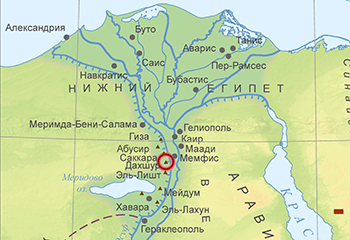
DAHSHUR — an Ancient Egyptian necropolis, one of several in Southern Memphis. It gets its name from an eponymous Arab settlement. Dahshur is situated on the western bank of the Nile about 30 km southwest of Cairo and 8 km southwest of Memphis.


Fig. 1. Map of Egypt, with Main Archaeological Sites

Fig. 2. Map of Dahshur, Archaeological Sites Location

Fig. 3. Landscape of Dahshur: View from the Extinct Dahshur Lake.
Photo: © S. E. Malykh

Fig. 4. Bent Pyramid of Seneferu in Dahshur and Its Satellite Pyramid.
Photo: © Merlin74 / Shutterstock.com

Fig. 5. Red Pyramid of Seneferu in Dahshur.
Photo: © Nick Brundle Photography / Shutterstock.com
DAHSHUR — an Ancient Egyptian necropolis, one of several in Southern Memphis on the western bank of the Nile about 30 km southwest of Cairo and 8 km southwest of Memphis (Fig. 1). It gets its name from an eponymous Arab settlement. Dahshur consists of several sites, the main of which date back to the Old Kingdom (Fourth–Sixth Dynasties, from the 26th century to the beginning of the 22nd century BC) and to the Middle Kingdom (Twelfth and Thirteenth Dynasties, from the end of the 21st century to the beginning of the 17th century BC). There are also tombs of the New Kingdom in the northeastern part of the necropolis.
History of Excavations and Research
Grandeur in size, the Dahshur pyramids have attracted attention since ancient times. Their scientific study was initiated in the mid-19th century by K. R. Lepsius’ team [Lepsius 1897: 206–207] and continued by J. de Morgan [Morgan 1895; 1903], A. Barsanti [Barsanti 1902], G. Jéquier, A. S. M. Hussein, A. Varille [Varille 1947], and A. Fakhry together with W. K. Simpson and H. Mustapha [Fakhry 1954; 1959; 1961; Mustapha 1954]. Starting in the 1970s, R. Stadelmann and D. Arnold made their significant contributions to the research [Stadelmann 1980; 1983; Stadelmann et al. 1993; Arnold D. 1987; 2002]. Since the 1980s, a Japanese archaeological mission has been working in Northern Dahshur [Yoshimura, Hasegawa 2001; Hasegawa 2003], measuring the pyramids and the chambers inside them. This expedition has also discovered and excavated the kings’ temples near the pyramids and the Valley Temple of the Bent Pyramid of Seneferu, the mastaba tombs of the Old Kingdom, and tombs of the Middle and New Kingdoms.
Description of the Archaeological Complex
The archaeological complex covers an area of over 1,200 ha (around 4×3 km), a part of an elevated section of the Libyan Desert (Fig. 2) northwest of the Dahshur Lake, once a seasonally filled body of water, now a plot of cultivated land. The main monuments of the architectural complexes (Fig. 3) are the two pyramids of the king Seneferu (Fourth Dynasty), the 105-metre-high Bent (due to its shape, see below), or Rhomboidal, Pyramid and the 105-metre-high Red, or Pink, Pyramid. Both monuments are built of local limestone with the white Tura limestone coating. Most of the cladding of the Bent Pyramid is largely intact, while cladding on the Red Pyramid has not survived. The ensemble also includes the so-called Black Pyramid, a mudbrick pyramid of king Amenemhat III (Twelfth Dynasty), the ruins of the pyramids of Amenemhat II and Senwosret III, as well as a few nameless monuments located to the north.
There are several theories regarding the shape of the Bent Pyramid of Seneferu in Dahshur. According to one of them, damage to the stone foundation forced the ancient builders to change the angle of incline from the initial 54°27’44” to the more gradual 43°22’ to reduce the weight of the structure. Other explanation suggests that the angle was reduced to speed up the process of building. Third version states that this was the intended shape of the pyramid [Varille 1947; Fakhry 1959; Lehner 1997: 102].
The royal architectural complexes of Seneferu include pyramid temples by the Eastern side of the pyramids (Upper Temples), possibly illustrating the initial architectural plan of the pyramids [Ricke 1954]. There also is a small Satellite Pyramid of the Bent Pyramid, which, probably, served for the ritual burial of Ka, the king’s double (Fig. 4), and the so-called Valley, or Lower, Temple connected to the Upper Temple by a processional causeway. The Upper Temple is a small cult chapel made of mud brick with a sacrificial altar and two limestone stelae. The Valley Temple is bigger and is decorated with reliefs and statues of Seneferu and a procession of people carrying sacrificial offerings [Fakhry 1961, 1]. Some of these reliefs have been moved to the Egyptian Museum in Cairo.
The Red Pyramid of Seneferu (Fig. 5) is considered the resting place of the king. The Upper Temple here is bigger than at the Bent Pyramid; its main areas include a shrine, treasury, hypostyle hall, and storerooms. It was hastily completed after Seneferu’s death, probably by his son Khufu [Savel'eva 1992: 39; Lehner 1997: 105]. A processional causeway leads east, presumably to the Valley Temple, which is yet to be discovered. The pyramidion, a Red Pyramid’s capstone made of Tura limestone, has been excavated and is exhibited next to the pyramid.
The finds at the Seneferu pyramid complexes include stone tools, fragments of stone, and ceramic vessels, including miniature votive models found inside the temples of both pyramids, in the surrounding compound, and also in the Valley Temple of the Bent Pyramid [Malykh 2010: 171–173; Fakhry 1961, 2: 106, 135–139; Arnold Do. 1982; Faltings 1989: 135–137, 142; Köpp 2009].
To the east of the Old Kingdom pyramids, there are orderly rows of stone mastabas of the kings’ relatives and the high nobility of the Fourth Dynasty, and more modest tombs of officials of the Fifth and Sixth Dynasties [Morgan 1895; 1903; Barsanti 1902; Stadelmann et al. 1993; El-Ghandour, Alexanian 2005].
The pyramid complexes of Seneferu were in use for a long time. A decree by Pepi I, a king of the Sixth Dynasty, grants certain privileges to two settlements near the ‘Seneferu Shines’ pyramid in Dahshur [Savel'eva 1992: 40, 142–143]. These complexes were probably abandoned during the First Intermediate Period but restored in the time of the Twelfth Dynasty when some kings chose to build their pyramids in Dahshur [Fakhry 1954: 574–576, 593].
The pyramids of kings Amenemhat II and Senwosret III (Twelfth Dynasty) are built of mudbricks and covered by limestone slabs. They are severely damaged now; roughly estimated, their original height was 80 m. The height of a better-preserved Black Pyramid of Amenemhat III (Fig. 6) was 75 m. A grey granite pyramidion found near the Black Pyramid is displayed at the Egyptian Museum in Cairo.
The pyramid complexes built during the reign of the Twelfth Dynasty had typical layout for that time. They consist of Upper Temples and high nobility burials, including the kings’ wives and daughters, connected by underground galleries with niches for sarcophagi, looted by the time of discovery. In one of such burials at the pyramid of Senwosret III, J. de Morgan found in 1984 ‘the Treasure of Dahshur’. It consisted of two chests of jewellery made of gold, precious and semi-precious stones, and glass paste belonging to princesses Merit and Sithathor, as well as breastplates bearing the names of Senwosret III and Amenemhat III [Morgan 1895: 64–72, pl. XIX–XXV; Arnold D. 2002: 68–75].
More modest burials of the Middle Kingdom nobels are located in North Dahshur. Some of the finds there shed the light on various burial and memorial practices [Baba, Yoshimura 2011].
The ruins of the mud pyramid of King Ameny Qemau (Thirteenth Dynasty) were discovered southeast of Lake Dahshur on the border with Mazghuna. Canopic jar fragments inscribed with the king’s name were found inside the pyramid and attest its provenance. The burial chamber is hewn out of a monolithic quartzite block similar to the one in the pyramid of Amenemhat III in Hawara (Faiyum Oasis).
Stone tombs of the New Kingdom (mostly of the Eighteenth and Nineteenth Dynasties, mid-16th to 13th centuries BC) are located to the northeast of the Red Pyramid of Seneferu in Dahshur. These tombs consist of a shaft with a burial chamber. They have all been looted; the remained grave goods found there include mainly burial jars, some of them with traces of ritual ‘killing’ and the ceremony of ‘Breaking of Red Pots’ (sedj desherut / sD dSrwt) [Takahashi 2022].
Significance of the Site and its Historical Role
The Dahshur Necropolis site is important for studying the evolution of ancient Egyptian pyramid and temple architecture, the development of burial customs and the funerary cult, and the overall material culture. Negatively affecting the ongoing research is the human activity along the boundaries of the site, especially after the Egyptian Revolution of 2011. Waste storage facilities of Mazghuna settlement and encroachment by modern cemeteries in the eastern part of the site are destroying the unexplored archeological areas.

Fig. 8. Black Pyramid of Amenemhat III in Dahshur.
Photo: © Nick Brundle Photography / Shutterstock.com
Bibliography
Arnold D. 1987 — Arnold, D. Der Pyramidenbezirk des Königs Amenemhet III. in Dahschur I. Bd. 1. Die Pyramide. Mainz am Rhein: Philipp von Zabern, 1987. (Archäologische Veröffentlichungen; 53). Arnold D. 2002 — Arnold, D. The Pyramid Complex of Senwosret III at Dahshur: Architectural Studies. New York: Metropolitan Museum of Art, 2002. Publications — Publications of the Metropolitan Museum of Art Egyptian Expedition, vol. 26. Arnold Do. 1982 — Arnold, Do. “Keramikbearbeitung in Dahschur 1976–1981.” Mitteilungen des Deutschen Archäologischen Instituts, Abteilung Kairo, Bd. 38, 1982, S. 25–65. Baba, Yoshimura 2011 — Baba, M., and S. Yoshimura. “Ritual Activities in Middle Kingdom Egypt: A View from Intact Tombs Discovered at Dahshur North.” Abusir and Saqqara in the year 2010, eds. M. Barta, F. Coppens, J. Krejčí, vol. 1, Prague: Czech Institute of Egyptology, Charles University in Prague, 2011, pp. 158–170. Barsanti 1902 — Barsanti, A. “Rapport sur la fouille de Dahchour.” Annales du Service des Antiquités de l’Égypte, t. 3, 1902, pp. 198–205. El-Ghandour, Alexanian 2005 — El-Ghandour, M., and N. Alexanian. “An Old Kingdom Cemetery in Southern Dahshur.” Mitteilungen des Deutschen Archäologischen Instituts, Abteilung Kairo, Bd. 61, 2005, S. 191–206. Fakhry 1954 — Fakhry, A. “The Excavation of Snefru’s Monuments at Dahshur: Second Preliminary Report.” Annales du Service des Antiquités de l’Égypte, t. 52, fasc. 52, 1954, pp. 563–594. Fakhry 1959 — Fakhry, A. The Monuments of Snefru at Dahshur. Vol. 1. The Bent Pyramid. Cairo: General Organisation for Government Printing Offices, 1959. Fakhry 1961 — Fakhry, A. The Monuments of Snefru at Dahshur. Vol. 2. The Valley Temple. Cairo: General Organisation for Government Printing Offices, 1961. Faltings 1989 — Faltings, D. “Die Keramik aus den Grabungen an der nördlichen Pyramide des Snofru in Dahchur: Arbeitsbericht über die Kampagnen 1983–1986.” Mitteilungen des Deutschen Archäologischen Instituts, Abteilung Kairo, Bd. 45, 1989, S. 133–154. Hasegawa 2003 — Hasegawa, S. “The New Kingdom Necropolis at Dahshur.” Egyptology at the Dawn of the Twenty-first Century: Proceedings of the Eighth International Congress of Egyptologists, Cairo, 2000, eds. Z. Hawass, L. P. Brock, vol. 1. Cairo: American University in Cairo Press, 2003, pp. 229–233. Köpp 2009 — Köpp, H. “Die Rote Pyramide des Snofru in Dahschur — Bemerkungen zur Keramik.” Studies on Old Kingdom Pottery, eds. T. I. Rzeuska, A. Wodzińska. Warsaw: Neriton, 2009, pp. 61–69. Lehner 1997 — Lehner, M. The Complete Pyramids. London: Thames and Hudson, 1997. Lepsius 1897 — Lepsius, C. R. (ed.). Denkmäler aus Aegypten und Aethiopien. Textbd. 1. Unteraegypten und Memphis. Leipzig: J. C. Hinrichs’sche Buchhandlung, 1897. Malykh 2010 — Malykh, S. E. Votivnaia keramika Egipta ėpokhi Drevnego tsarstva [Egyptian Votive Pottery of the Old Kingdom]. Moscow: IV RAN, 2010 (in Russian). Morgan 1895 — Morgan, J. de. Fouilles à Dahchour, mars–juine 1894. Vienne: Adolphe Holzhausen, 1895. Morgan 1903 — Morgan, J. de. Fouilles à Dahchour en 1894–1895. Vienne: Adolphe Holzhausen, 1903. Mustapha 1954 — Mustapha, H. “The Surveying of the Bent Pyramid at Dahshur.” Annales du Service des Antiquités de l’Égypte, t. 52, fasc. 2, 1954, pp. 595–602. Ricke 1954 — Ricke, H. “Baugeschichtlicher Vorbericht über die Kultanlagen der südlichen Pyramide des Snofru in Dahschur.” Annales du Service des Antiquités de L’Égypte, t. 52, fasc. 2, 1954, pp. 603–623. Savel'eva 1992 — Savel'eva, T. N. Khramovye khoziaistva Egipta vremeni Drevnego tsarstva (III–VIII dinastii) [Temple Economy of Egypt of the Old Kingdom (Third–Eighth Dynasties)]. Moscow: Nauka, 1992 (in Russian). Stadelmann 1980 — Stadelmann, R. “Snofru und die Pyramiden von Meidum und Dahschur.” Mitteilungen des Deutschen Archäologischen Instituts, Abteilung Kairo, Bd. 36, 1980, S. 437–449. Stadelmann 1983 — Stadelmann, R. “Die Pyramiden des Snofru in Dahschur: zweiter Bericht über die Ausgrabungen an der nördlichen Steinpyramide.” Mitteilungen des Deutschen Archäologischen Instituts, Abteilung Kairo, Bd. 39, 1983, S. 225–241. Stadelmann et al. 1993 — Stadelmann, R., and N. Alexanian, H. Ernst, G. Heinde, D. Raue. “Pyramiden und Necropole des Snofru in Dahschur: dritter Vorbericht über die Grabungen des Deutschen Archäologischen Instituts in Dahschur.”Mitteilungen des Deutschen Archäologischen Instituts, Abteilung Kairo, Bd. 49, 1993, S. 259–294. Takahashi 2022 — Takahashi, K. “The Function of New Kingdom Pottery Vessels from Tomb 30 at Dahshur North.” Bulletin de liaison de la céramique égyptienne, vol. 31, 2022, pp. 201–233. Varille 1947 — Varille, A. À propos des pyramides de Snéfrou. Le Caire: Imprimerie Schindler, 1947. Yoshimura, Hasegawa 2001 — Yoshimura, S., and S. Hasegawa. “New Kingdom Necropolis at Dahshur: The Tomb of Ipay and Its Vicinity.” Abusir and Saqqara in the year 2000, eds. M. Barta, J. Krejčí. (Archiv orientální. Supplementa; 9). Prague: Academy of Sciences of the Czech Republic, Oriental Institute, 2001, pp. 145–160.