Buto
Publication date: 11.05.2025
- Alternative name:
- Tell el-Fara’în; Kom el-Fara’în
- Region:
- Northeastern Africa
- Timespan:
- 4th millennium BC — 6th century AD
- Coordinates:
- 31.2
30.74
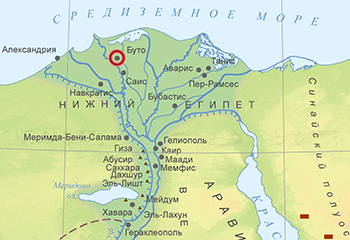
BUTO — one of the oldest cities in Egypt and the main site of the Maadi culture. Located northwest of the Nile Delta in the Kafr el-Sheikh Governorate.


Fig. 1. Map of Ancient Egypt, with Main Urban Centres and Archaeological Sites

Fig. 2. Wooden Tablet of King Horus Aha with a Drawing of Sanctuary of Djebaut. 2a. Drawing. In: Petrie, W. M. F. The Royal Tombs of the Earliest Dynasties. Pt. 2. London: Egypt Exploration Fund, 1901. Pl. X, 2. 2b. Photo: Distribution from the Egypt Exploration Fund, 1901 / © Penn Museum. URL: https://www.penn.museum/collections/object/122418 (accessed: 24.12.2024)

Fig. 3. Map of ‘Labyrinth’ Building in Buto with Marked Entrances.
In: Hartung, U. “Recent Investigations of Early Dynastic Building Structures at Tell el-Faraʽin/Buto.” Ancient Egyptian and Ancient Near Eastern Palaces: Proceedings of the Conference on Palaces in Ancient Egypt, held in London 12th–14th June 2013, organised by the Austrian Academy of Sciences, the University of Würzburg and the Egypt Exploration Society, edited by M. Bietak, and S. Prell, Vienna: Austrian Academy of Sciences Press, 2018, vol. 1, pp. 101–112. Publications — Denkschriften der Gesamtakademie, Bd. 83; Contributions to the Archaeology of Egypt, Nubia and the Levant, vol. 5.
BUTO (AncientGreek: Βουτώ; Arabic: Tell el-Fara’în or Kom el-Fara’în, ‘Mound of the Pharaohs’) — one of the oldest cities in Egypt and the main site of the Maadi culture. It was located northwest of the Nile Delta in the Kafr el-Sheikh Governorate, about 40 km from the Mediterranean Sea and 20 km south of the Burullus Lake. Buto emerged in the 4th millennium BC and existed until the 6th century AD.
Location
The city originated on a gezira, a Pleistocene or Early Holocene sand formation rising above an alluvial plain. It may have initially been a port on a seashore. Buildings and products typical of the Maadi culture have been found in the lower layers of the ancient site. Meanwhile, types of pottery decoration, stone tools, and architectural decorations indicate a close connection between early Buto and the territories of Palestine, Syria (Amuk), and through the latter, Mesopotamia of the Uruk Period.
Historical Significance
Buto was likely the capital of the Predynastic ‘Northern Kingdom’ (Fig. 1). It was known as Pe (8), Dep (8p), or Djebaut (9bawt), the toponyms referred to different areas of the settlement. Djebaut, for example, referred to the sanctuary where the heron and the running bull were worshipped (Fig. 2). The three names already appear in early Egyptian writing sources of the Predynastic and Early Dynastic times, for example, on bone labels and cylinder seal impressions. Buto may have played an important role in the territorial and political unification of Egypt during the final stage of the Predynastic Period (end of the 4th millennium BC). It apparently fell into decline during the Old Kingdom, and is not mentioned in written sources of the Middle Kingdom. From the time of the Ramessides (New Kingdom), the city was known as Per-Wadjet (Pr-WADt), i.e. ‘The House of (cobra goddess) Wadjet’, or ‘Uto’, from which the Greek name ‘Buto’ may have originated. In addition to Wadjet, a variety of gods was worshipped here — the so-called Souls of Pe-Dep (BAw P-8p) associated with Lower Egypt. The city was part of the 6th nome (Xoite) of Lower Egypt. Ptolemy’s Introduction to Geography (IV, 5) mentions Buto as the centre of the Phthenotes nome in the Nile Delta. Herodotus (II, 152) and Strabo (XVII, I, 18) write of an oracle of the goddess Latona (Leto) located in Buto. The city was most active from the end of the 8th century BC to the Roman Period. By the 4th century AD, its population had significantly declined, and it was abandoned in the 6th century.
Discoveries, Study, and Chronology
The location of Buto was discovered by W. M. F. Petrie in 1886. Trial excavations were conducted here by Canadian archaeologist C. Currelly in 1904, but the cultural layers dating before the Late Period lay flooded by groundwater and were practically inaccessible [Petrie 1905: 36–38]. In the 1960s, British archaeologists M. V. Seton-Williams and D. Charlesworth excavated the city’s Roman, Ptolemaic, and Late Period layers [Seton-Williams 1965; 1966; 1967; 1969; Charlesworth 1970]. In 1983, W. Kaiser launched a geological and archaeological excavation project of the German Archaeological Institute with the participation of other organisations, including the University of Poitiers. The project has been ongoing from 1985 to the present day (T. von der Way, D. Faltings, U. Hartung, P. Ballet, etc.). The archaeologists utilised motorised vacuum pumps to explore Buto’s flooded Predynastic and Early Dynastic strata below the groundwater [Faltings, Köhler 1996; Faltings et al. 2000; Hartung 2018; Hartung et al. 2003; 2007; 2009; 2012; 2016; 2019; Way 1988; 1997].
The area of the archaeological site is approximately one square kilometre, while the cultural layer is up to 24 m thick. The site consists of three mounds (Kôms), Kôms A, B, and C, whereby Kôm A (north) and Kôm C (south) make up the residential sector. Kôm A is adjacent to a Greco-Roman cemetery, while Mound B is flanked by a temple from the east. So far, archaeologists have identified and dated seven layers: Layers I–II (second half of the 4th millennium BC) from the Predynastic Period, Layers III–V (end of the 4th to beginning of the 3rd millennium BC) from the Predynastic and Early Dynastic Periods, Layer VI (second quarter of the 3rd millennium BC) from the Old Kingdom, and Layer VII (7th to 6th centuries BC) from the Late Period. Archaeological work has also uncovered the remains of Ptolemaic and Roman buildings.
Archaic Palace
The most prominent discovery in Buto is a large building in the southwest of Kôm A. This ‘labyrinth’ building or ‘royal estate’ was constructed of mudbrick, wood, and stone. It was up to 50 m wide (the full length has yet to be determined due to modern construction) and surrounded by a brick wall. The structure was built in the Late Predynastic Period (end of the 4th millennium BC), renovated and expanded by the end of the First Dynasty, i. e. around the turn of the 30th to 29th centuries BC, but destroyed by fire at the end of the Second Dynasty, i. e. at the turn of the 29th century to the 28th century BC. During its heyday, the structure comprised private rooms, workshops, warehouses, and possibly religious spaces. The entrance consisted of a long corridor running from the door and turning repeatedly at right angles before reaching the central reception area [Hartung 2018] (Fig. 3).
Greco-Roman Town
Work in the western section of Kôm A revealed large red brick houses dating to the 2nd century BC — 4th century AD, where the remains of stone vessels of the First Dynasty were found. These, apparently, had initially been discovered by the original residents of these houses, who pulled them out from the settlement’s oldest layers. The nearby contemporary cemetery was severely damaged by farmers in later times, who would dig up the ancient cultural strata in search of sebakh— decomposed mudbricks rich in nitrogen and organic matter, which served as fertiliser for the Egyptian fellahin. Burial types include ceramic coffins buried in pits, jar burials in two large jars joined along the wide necks, and child burials in amphorae, of which the upper portion was cut off to accommodate the bodies and the heads placed facing east. The site was covered with sherds of very high-quality pottery imitating the Attic style, testifying to the advanced level of ceramic production in Late Buto. The round pottery kilns of brick found in the northern section of Kôm A were in operation from the end of the 1st millennium BC to the beginning of the 1st millennium AD.
Bathhouse
An urban bathhouse lying in the western section of Kôm A is of particular interest. Located between Kôms A and B, the brick and stone building covered an area of about 25×20 m, and was in operation from the 2nd century BC to the 2nd century AD. Its remains were excavated in the 1960s and in 2008–2011. In the 2nd century AD, the original ‘Greek’ structure, which contained round public rooms in the form of a beehive (tholos) with hip baths along the walls, was replaced by Roman baths (thermae) with stoves, a hypocaust system (heated floors), and latrines, rendering it a unique complex in Egypt at the beginning of the new era (Fig. 4) [Ballet, Marouard 2012; Lecuyot, Redon 2014].
Temple
The stone temple on Kôm B was probably built in the Late Period and is associated with the sanctuary of the goddess Leto (Wadjet) described by Classic authors. The temple grounds covered an area of about 300×200 m and were surrounded by a high brick wall, of which more than 10 m height has survived to this day. Walkways between Kôms A and C led to the main entrance on the west side. There were two stairwells (possibly nilometers) inside the temple enclosure. Royal stelae and statues of Thutmose III, Ramesses II, etc. were found in the enclosure, together with a large granite statue of a falcon without inscriptions. Egyptologists attribute the latter to the Twenty-Sixth Dynasty (Sais) based on stylistic criteria. The Satrap Stela (311 BC) reports that Ptolemy, the son of Lagus, transferred ownership of the ‘Land of Wadjet’ to the temples of Buto (which clearly included this one) [Ladynin 2022]. The temple lost its importance under the Romans and was partially dismantled.
.jpg)
Fig. 4. Public Bath in Buto.
Photo: © SCA. URL: https://balneorient.hypotheses.org/2242 (accessed: 09.09.2024)
Bibliography
Ballet, Marouard 2012 — Ballet, P., and G. Marouard. “Workshops and Urban Settlement in Buto.” Egyptian Archaeology: Bulletin of the Egypt Exploration Society, no. 40, 2012, pp. 14–17. Charlesworth 1970 — Charlesworth, D. “The Tell el-Farâʽîn Excavation, 1969.” Journal of Egyptian Archaeology, vol. 56, 1970, pp. 19–28. Faltings, Köhler 1996 — Faltings, D., and E. C. Köhler. “Vorbericht über die Ausgrabungen des DAI in Tell el-Faraʽin/Buto 1993 bis 1995.” Mitteilungen des Deutschen Archäologischen Instituts, Abteilung Kairo, Bd. 52, 1996, S. 87–114. Faltings et al. 2000 — Faltings, D., P. Ballet, F. Förster, P. G. French, C. Ihde, H. Sahlmann, J. Thomalsky, C. Thumshirn, and A. Wodzinska. “Zweiter Vorbericht über die Arbeiten in Buto von 1996 bis 1999.” Mitteilungen des Deutschen Archäologischen Instituts, Abteilung Kairo, Bd. 56, 2000, S. 131–179. Hartung 2018 — Hartung, U. “Recent Investigations of Early Dynastic Building Structures at Tell el-Faraʽin/Buto.” Ancient Egyptian and Ancient Near Eastern Palaces: Proceedings of the Conference on Palaces in Ancient Egypt, held in London 12th–14th June 2013, Organised by the Austrian Academy of Sciences, the University of Würzburg and the Egypt Exploration Society, edited by M. Bietak, S. Prell, Vienna: Austrian Academy of Sciences Press, 2018, Vol. 1, pp. 101–112. Publications — Denkschriften der Gesamtakademie Bd. 83; Contributions to the Archaeology of Egypt, Nubia and the Levant, vol. 5. Hartung 2021 — Hartung, U. “Recent Excavations in the Late Predynastic Settlement of Tell el-Fara’in/Buto.” Egypt at Its Origins 6: Proceedings of the Sixth International Conference “Origin of the State. Predynastic and Early Dynastic Egypt”, Vienna, 10th–15th September 2017, edited by Köhler, E. C., N. Kuch, F. Junge, and A.-K. Jeske, Leuven; Bristol: Peeters, 2021, pp. 233–251. Publications — Orientalia Lovaniensia Analecta, vol. 303. Hartung et al. 2003 — Hartung, U., P. Ballet, F. Béguin, J. Bourriau, P. French, T. Herbich, P. Kopp, G. Lecuyot, and A. Schmitt. “Tell el-Faraʽin — Buto: 8. Vorbericht.” Mitteilungen des Deutschen Archäologischen Instituts, Abteilung Kairo, Bd. 59, 2003, S. 199–267. Hartung et al. 2007 — Hartung, U., P. Ballet, F. Béguin, J. Bourriau, D. Disneuf, A. von den Driesch, P. French, R. Hartmann, T. Herbich, C. Kitagawa, P. Kopp, G. Lecuyot, M.‑D. Nenna, A. Schmitt, G. Şenol, and A. Şenol. “Tell el-Faraʽin — Buto: 9. Vorbericht.” Mitteilungen des Deutschen Archäologischen Instituts, Abteilung Kairo, Bd. 63, 2007, S. 69–165. Hartung et al. 2009 — Hartung, U., P. Ballet, A. Effland, P. French, R. Hartmann, T. Herbich, H. Hoffmann, E. Hower-Tilmann, C. Kitagawa, P. Kopp, W. Kreibig, G. Lecuyot, S. Lösch, G. Marouard, A. Nerlich, M. Pithon, and A. Zink. “Tell el-Faraʽin — Buto: 10. Vorbericht.” Mitteilungen des Deutschen Archäologischen Instituts, Abteilung Kairo, Bd. 65, 2009, S. 83–190. Hartung et al. 2012 — Hartung, U., E.‑M. Engel, and R. Hartmann. “Tell el-Faraʽin — Buto: 11. Vorbericht.” Mitteilungen des Deutschen Archäologischen Instituts, Abteilung Kairo, Bd. 68, 2012, S. 83–114. Hartung et al. 2016 — Hartung, U., R. Hartmann, K. Kindermann, H. Riemer, and W. Stähle. “Tell el-Faraʽin — Buto: 12. Vorbericht.” Mitteilungen des Deutschen Archäologischen Instituts, Abteilung Kairo, Bd. 72, 2016, S. 73–126. Hartung et al. 2019 — Hartung, U., R. Hartmann, K. Kindermann, V. Linseele, M. Ownby, and H. Riemer. “Tell el-Faraʽin — Buto: 13. Vorbericht.” Mitteilungen des Deutschen Archäologischen Instituts, Abteilung Kairo, Bd. 75, 2019, S. 147–196. Ladynin 2022 — Ladynin, I. A. Ptolemeĭ, syn Laga, i zhretsy Buto. “Stela satrapa” (Egipetskiĭ muzeĭ, Kair, 22182): ieroglificheskiĭ tekst, perevod i kommentariĭ [Ptolemy, Son of Lagus, and the Priests of Buto. The Satrap Stela (Egyptian Museum, Cairo, 22182): Hieroglyphic Text, Translation and Commentary]. Moscow; St. Petersburg: RHGA, 2022 (in Russian). Lecuyot, Redon 2014 — Lecuyot, G., and B. Redon. “Les bains de Tell el-Fara‛in/Bouto (Égypte): rapport préliminaire (2008–2009).” 25 siècles de bain collectif en Orient: Proche-Orient, Égypte et péninsule Arabique: balaneia, thermae, hammamat, éd. par M.-F. Boussac, S. Denoix, T. Fournet, B. Redon, Le Caire: Institut français d’archéologie orientale, 2014, pp. 281–290. Publications — Études urbaines, vol. 9. Petrie 1905 — Petrie, W. M. F. Ehnasya, 1904 / with chapter by C. T. Currelly. London: Egypt Exploration Fund, 1905. Publications — Egypt Exploration Fund. Memoir vol. 26. Seton-Williams 1965 — Seton-Williams, M. V. “The Tell el-Farâʽîn Expedition, 1964–1965.” Journal of Egyptian Archaeology, vol. 51, 1965, pp. 9–15. Seton-Williams 1966 — Seton-Williams, M. V. “The Tell el-Farâʽîn Expedition, 1966.” Journal of Egyptian Archaeology, vol. 52, 1966, pp. 163–171. Seton-Williams 1967 — Seton-Williams, M. V. “The Tell el-Farâʽîn Expedition, 1967.” Journal of Egyptian Archaeology, vol. 53, 1967, pp. 146–155. Seton-Williams 1969 — Seton-Williams, M. V. “The Tell el-Farâʽîn Expedition, 1968.” Journal of Egyptian Archaeology, vol. 55, 1969, pp. 5–22. Way 1988 — Way, T. von der. “Investigations Concerning the Early Periods in the Northern Delta of Egypt.” The Archaeology of the Nile Delta, Egypt: Problems and Priorities. Proceedings of the Seminar held in Cairo, 19–22 October 1986, on the Occasion of the 15th Anniversary of the Netherlands Institute of Archaeology and Arabic Studies in Cairo, edited by E. C. M. van den Brink, Amsterdam: Netherlands Foundation for Archaeological Research in Egypt, 1988, pp. 245–249. Way 1997 — Way, T. von der. Tell el-Faraʽîn — Buto I: Ergebnisse zum frühen Kontext. Kampagnen der Jahre 1983–1989. Mainz am Rhein: Philipp von Zabern, 1997. Publications — Archäologische Veröffentlichungen, vol. 83.