Mysterious Temple Inscription Excavated at Artesian (Crimea)
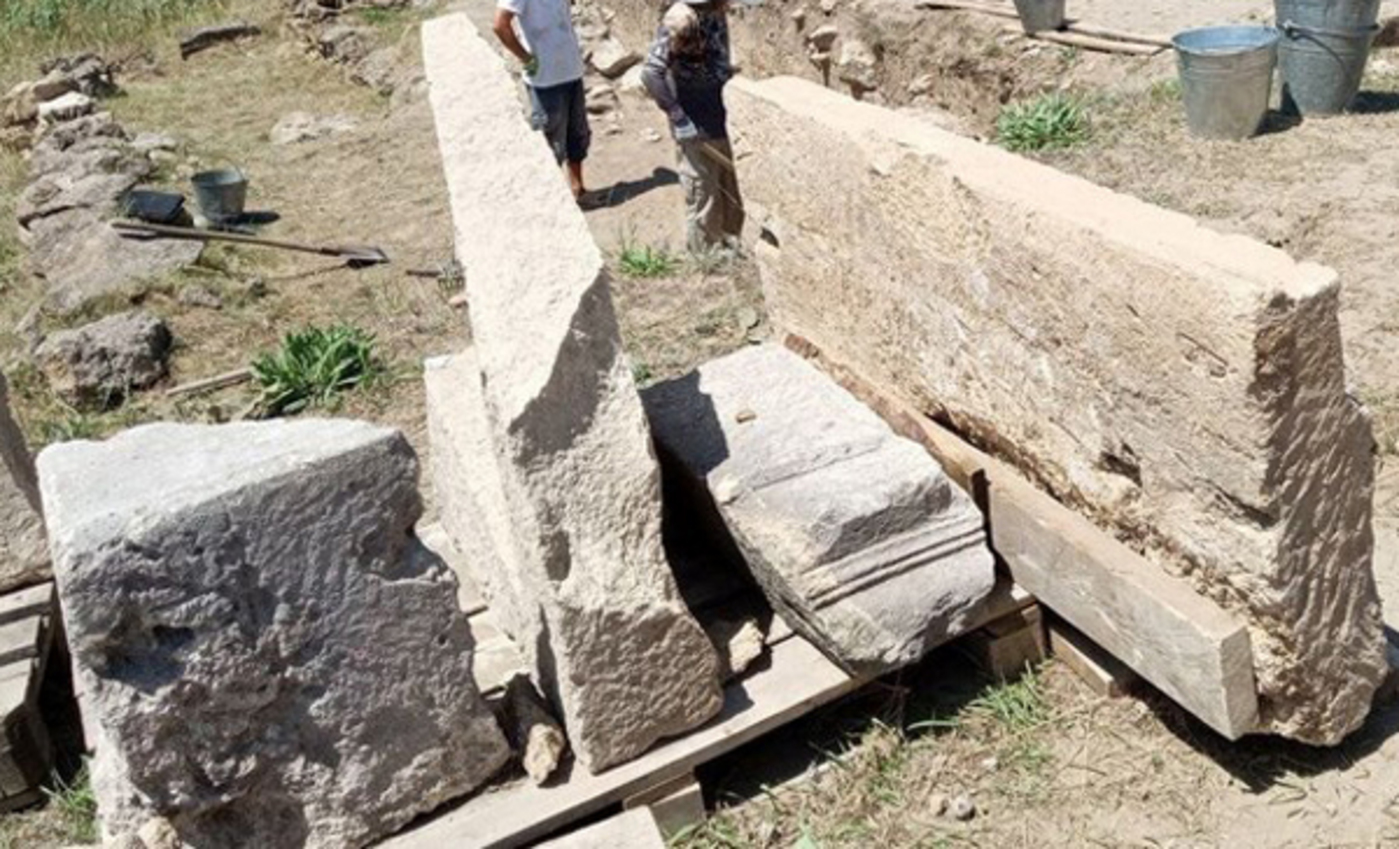
Fragments of the inscribed architraveFrom the Temple of Zeus Genarch Excavations.
Photo: Artesian Archaeological Expedition
In 2023, a Moscow Pedagogical State University (MPSU) archaeological expedition discovered the remnants of buildings and architecture that were identified as part of the Temple of Zeus Genarch in the southern part of the Artesian settlement. The most striking discovery was a male head with a diadem sculpted from white marble, which the Director of MPSU’s Centre for Archaeological Research, Nikolay I. Vinokurov, suggests may be a fragment of a statue of Zeus Genarch. Another the Artesian expedition’s most interesting discovery was fragments of an architrave, which had been used to close a niche grave and offering pits surrounding it in the 4th century AD. A dedicatory inscription which was preserved on the architrave allowed Vladimir Yaylenko, a historian and art historian at Saratov State University, to infer that the original text may have been connected with Pharnaces II, the ruler of the Bosporan Kingdom (63–51/50 BC). According to the researcher, the inscription could have been created to commemorate a successful military campaign launched by the king against the Crimean Scythians.
Yury P. Zaitsev, Director of the Historical and Archaeological Museum-Reserve ‘Scythian Neapolis’ and an Oikoumene’s Editorial Board Member, believes that it is hard to overestimate the importance of this find. Such informative epigraphic sources, especially in a reliable archaeological context, are extremely rare and of great significance. From the perspective of the archaeological study of Crimean Barbaricum, the specific mention of the victory of the Bosporans over the Scythians, dated to around the mid-1st century BC, acquires particular value. Comparing this date with the stratigraphy and chronology of several recently investigated settlements and sites of Crimean Scythia opens up great opportunities and prospects for reconstructing the military and political history of the Northern Black Sea region in the Late Hellenistic and Early Roman Periods.