New Pyramid Discovered in Peru
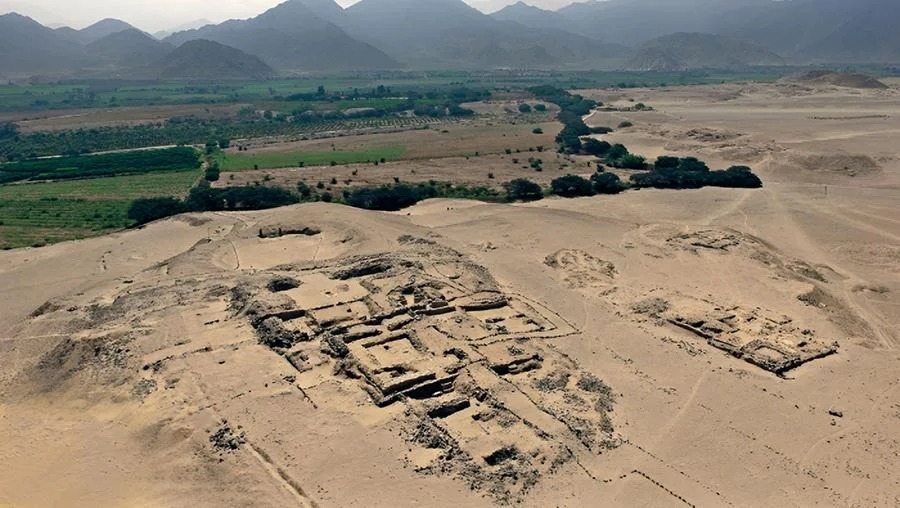
A View of the Excavations at Chupasigarro
Photo: Caral Archaeological Zone – Ministry of Culture of Peru
Peru’s Ministry of Culture reports new discoveries in the Caral archaeological zone (Supe River Valley) — one of the most important centres of the Norte Chico cultural tradition (3000–1800 BC), where the Andean civilisation first formed. A previously unknown small platform, or ‘huaca’, which functioned as a cult-religious structure, was discovered under shrubbery at the Chupasigarro site, which is located one kilometre northwest of the Caral ceremonial complex. The Chupasigarro pyramid is a small three-tiered platform with the remains of a rectangular sanctuary at its summit, marked by vertically installed megaliths, or ‘huancas’. A central staircase led up to the sanctuary.
The Chupasigarro archaeological site is in the immediate vicinity of Caral, so studying it is of great importance for understanding the socio-economic organisation and cultural traditions of the Norte Chico community. The site covers more than 38 hectares, where 12 large structures of ritual or public significance have been discovered surrounded by residential buildings. Located near the coast in the lower reaches of the Supe River, the Chupasigarro settlement was likely a supplier of seafood, wood, and construction stone for Caral. Chupasigarro is also the only known location for observing one of the early geoglyphs — the head of a captive measuring 62.1×30.3 m carved into the slope of a mountain in the Supe Valley.
The Norte Chico archaeological culture belongs to the Late Preceramic Period (Late 4th — Early 2nd millennium BC). Its sites are located in the eponymous region of the central Peruvian coast, in the valleys of the Huaura, Supe, Pativilca, and Fortaleza rivers. More than 30 large archaeological sites are associated with this culture, the largest of which is Caral in the Supe River Valley, which was the centre of one of the first supra-community political formations in the Andes.