Xavante
Publication date: 25.05.2025
- Alternative name:
- Akuen, Akwen, A'uwe Uptabi, A'we, Chavante, Crisca, Pusciti, Tapacua
- Region:
- Amazonia
- Timespan:
- 18th century — to this day
The XAVANTE — indigenous people of South America living in the South and South-East of Brazil (Eastern Mato Groso, Southern Mato Grosso do Sul, Goiás, and Western São Paulo. There are Northern and Southern Xavante tribes.

.jpg)
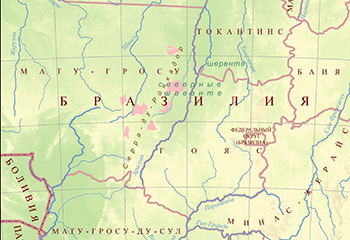
Fig. 1. Map of the Xavante people residence
.jpg)
Fig. 2. The Xavante man prepares the fibers of the buriti palm for weaving.
Photo: © A. A. Matusovsky
.jpg)
Fig. 3. The Xavante.
Photo: © A. A. Matusovsky
The XAVANTE — indigenous people of South America living in the South and South-East of Brazil (Eastern Mato Groso, Southern Mato Grosso do Sul, Goiás, and Western São Paulo) (Fig. 1). There are Northern and Southern Xavante tribes.
Naming and Identification
The Northern Xavante (also Akuen, Akwen, A'uwe Uptabi, A'we, Chavante, Crisca, Pusciti, Tapacua, or self-designated A'uwe — ‘people’ or A'uwe Uptabi — ‘real people’) inhabit approximately 80 villages in Eastern Mato Grosso and North-Western Goiás. There are roughly 22, 256 people (Siasi/Sesai 2020) who speak Xavante language, a core language of the Macro-Jê language family. About 7 thousand of them are monolingual; a majority knows Portuguese. Approximately 60 % of Xavante are Christians, 7.5 % of them are Protestants; traditional beliefs continue to play a significant role in their culture.
The Southern Xavante, or Ofayé (Ofaié-Xavante, Ofayé-Xavante, Opaié-Shavante, Opayé), numbering about 60 people, live in Mato Grosso do Sul, along the Ivinhema, Vacaria, and Verde rivers. They speak an isolated language, nearly extinct, while many also know Portuguese. Mostly Christians, they are almost totally assimilated in the Brazilian society. The Oti (Chavanteor Euchavante), now an extinct group, lived in the Western part of the state of São Paulo.
The Northern Xavante, living together with the Xerénte (self-appellation: Akwẽ) in the state of Tocantins, form an ethnolinguistic group known in the anthropological literature as Akuwẽ. During the colonial and imperial periods, the Akuwẽs were also referred to as Xakriabá or Acroá. These ethnonyms were created by Brazilians to identify and distinguish between different subgroups of Akuwẽ. In the records of travelers, bandeirantes and missionaries the Akuwẽ people were also called Tapuias.
The most accepted version is that the Brazilians used the name Xavante to distinguish these peoples from other Akuwẽ groups.
Geography and Culture
Xavante culture is typical for indigenous peoples in the South American Cerrado (a region of tropical savanna).
In Brazil, the Xavante inhabit the Central Cerrado, a landscape dominated by a mixture of tropical savanna and gallery forests. The region has two seasons: dry, or ‘winter’ (April to October), and rainy, or ‘summer’ (November to March). The Xavante’s traditional occupations are seasonal gathering (palm fruits, wild roots, fruit and vegetable), hunting (including drive hunting with the use of torches), slash-and-burn farming (sweet potato, maize, squash, cassava, beans, papaya), and fishing.
Each field belongs to a particular household, whose men prepare the ground by removing trees and burning the remains and women cultivate it by planting and tending the crops (Fig. 2).
The household owns the produce. Currently, gathering is practiced only by a handful of the Xavante; most live in settled communities, where they are engaged in agriculture and handicrafts production or labour in nearby towns.
The Xavante’s traditional settlements are semicircular and consist of several huts, with a bachelors’ hut at one of the extremities outside the village. The Xavante’s traditional house is horseshoe-shaped with one entrance, made of boughs and brushwood with walls touching the ground. There are no hammocks; the inhabitants sleep on the ground or on special floor mattresses.
They have preserved most of their traditional culture and social organisation.
The Xavante society is composed of three patrilineal clans and two exogamous moieties (poriza'õno and öwawe). Another binary principle of social organisation divides the Xavante people by age — two exogamous moieties are split into four age groups.
Xavante boys aged 7–10 start to live separately from the rest of the tribe in the bachelors’ huts hë (hö) and are called wapté — pre-initiated. The wapté boys stay in the bachelors’ hut for 1–5 years, getting instructed by elderly men belonging to the same exogamous moiety. The wapté boys acquire skills and knowledge necessary for initiation into manhood.
Girls have the same age divisions, but, unlike boys, they are not separated and live with their families.
After the period of isolation, boys go through an intricate initiation ceremony: their earlobes are pierced and they become adult males. A girl becomes an adult after giving birth to her first child.
The Xavante prefer cross-cousin marriage. Polygyny is frequent. The post-marital residence pattern is uxorilocal. The marriage ceremony, called adaba, is held after the couple has lived together for a certain amount of time and their union is deemed solid.
Both males and females have four stages of maturity: recently initiated, youth, adults, and the elderly. Dead people are regarded as ancestors; they can get reborn endlessly in a never-ending circle of life.
Naming is another element within a complex system of ceremonial exchanges between exogamous moieties. The Xavante’s male names do not only identify a person, but also indicate their bearers’ affiliation with a particular lineage within each of the two exogamous moieties (Fig. 3).
People from opposite moieties have frequent arguments about prestigious names.
The first public ceremony in which boys participate is a club fight, called ói’ó. Boys take part in these fights when they became capable of wielding a club. These fights symbolise the conflict between the boys’ fathers’ patrilineal exogamous moieties; they also cultivate and demonstrate the boys’ fighting spirit and ability to handle physical challenges.
There are also two other ceremonial athletic contests: the wa´ie fight (usually involving several girls attacking one man) and the relay race with a log of moriche palm — wa´ie uiwede. Either ceremony is a playful athletic competition between opposite exogamous moieties that serves to foster and show off physical strength and endurance — qualities highly valued in Xavante culture.
The relay is a short-distance race where every runner carries a heavy moriche palm log (men’s logs weighing approximately 80 kg each, and women’s 60 kg). Continuing to move, the runner transfers the log to the shoulder of another team member, belonging to the same age group and exogamous moiety. The run distance is 6–8 kilometres, and the race ends at the centre of the village. Participants of the race are always adults of the same sex, age group, and the same exogamous moiety.
Another important tradition in Xavante culture is collective singing and dancing, called da-ño're. The participants are also grouped by age and affiliation with a particular exogamous moiety.
The Xavante cherish their mythology, which includes stories about the sources and development of cultural values, origination of diseases, appearance of white people, and the adventures of mythical heroes.
Dreams are an important element of the traditional belief system. They play a role in getting a new age-based name and work as a channel for communicating with ancestors. During the ear-piercing ceremony, the newbie is given his first set of earrings, small wooden cylinders which, as believed, have strong dream-inducing powers. Nowadays young people compare the earrings to radio antennas: they empower men to ‘tune into’ their ancestors while sleeping. These objects symbolise a young man’s ability to translate his dreams into song, an important marker defining adult male’s social status.
Research History
Xavante interaction with the outside world were extensively covered by the mass media, and this coverage pictured them as courageous and freedom-loving people.
The first mention of Xavante is found in the early 19th-century writings of Austrian naturalist Johann Baptist Emanuel Pohl [Pohl 1832]. After the establishment of a peaceful contact with the Xavante, they were studied by many researchers who focused on different dimensions of their traditional culture and way of living: a history of dealing with an outside world [França 2000], mythology [Giaccaria, Heide 1991; Harrison 1994], different aspects of interactions between Xavante and newly arrived peoples [Lombardi 1985, Ravagnani 1991, Villas Bȏas 1997, Garfield 2001], the conversion of the Xavante to Christianity [Menezes 1999], and immunological research [Friedman 1992].
Main Recorded Historical Events
The Northern Xavante came into contact with Brazilians for the first time in the late 18th century and established stable contacts with them in the early 20th century.
In the early 18th century, after the discovery of gold mines in Goiás, there was an influx of newcomers — miners, bandeirantes, settlers and missionaries — to the tribal territories. It significantly affected the natives, causing conflicts between them and the new arrivals.
In the late 18th and early 19th centuries the Xavante’s ancestors crossed the Araguaia River and headed west.This migration marked a definitive split between the Xavante and the Xerénte, who remained on the stream’s Eastern bank.
Having traversed the Araguaia, the Xavante settled in Serra do Roncador, a part of what is now the state of Mato Grosso.Throughout the 19th century and up until the mid-20th century, different groups of the Xavante were migrating further west, either along the Rio das Mortes, or to the Suia-Miçu River and the headwaters of the Culuene River. Prior to the 1930s all the Xavante groups had very little contact with Brazilian society, and their traditional way of living generally remained intact. The Xavante interacted with Christian missionaries from the 1930s on.
The Xavante were combative. Until the mid-1950s they actively fought against the Brazilian colonists. After the pacification in the 1950s, a significant part of the Northern Xavante died of diseases. The peaceful coexistence with the Xavante was established only in the mid-1960s. From 1960s the group was settled along the missions and the posts of the National Indigenous People Foundation.
The Xavante spent the late 1970s and early 1980s warring for the return of their native lands and for the demarcation of lands in their possession.
By the end of 1981, six Xavante lands were demarcated: Areões, Pimentel Barbosa, São Marcos, Sangradouro, Marechal Rondom, and Parabubure.

Bibliography
França 2000 — França, M. S. C. de. Xavante, Pioneiros e Gaúchos: relatos heróicos de uma história de exclusão em Nova Xavantina. Dissertação de Mestrado. Brasília: Universidade de Brasília, 2000. Friedman 1992 — Friedman, H. Pênfigo foliáceo endêmico (fogo selvagem) entre índios Xavante: estudos imunológicos e imunogenéticos da reação auto-imune. Dissertação de Mestrado. Asunción: Universidad Católica, 1992. Garfield 2001 — Garfield, S. Indigenous struggle at the heart of Brazil: state policy, frontier expansion, and the Xavante Indians, 1937–1988. Durham: Duke University Press, 2001. Giaccaria, Heide 1991 — Giaccaria, B., and A. Heide Mitologia Xavante: mitos, leyendas, cuentos y sueños. Quito: Abya-Yala – Roma: Movimiento Laicos para America Latina, 1991 Harrison 1994 — Harrison, A. (ed.) Dahi'rata nhimirowatsu'u, Duréi watsu'u: histórias antigas do povo Xavante. Cuiabá: Sociedade Internacional de Lingüística, 1994. Coleção de Histórias Antigas do Povo Xavante. Circulação restrita. Lombardi 1985 — Lombardi, J. C.O Xavante e a política indigenista no Brasil nos séculos XVII e XIX. Dissertação de Mestrado. Piracicaba: Escola Superior de Agricultura “Luiz de Queiroz”, 1985. Maybury-Lewis 1984 — Maybury-Lewis, D. A sociedade Xavante. Trad. Aracy Lopes da Silva. Rio de Janeiro: Francisco Alves, 1984. Menezes 1999 — Menezes, C. “Missionários e guerreiros: o apostolado salesiano entre os Xavante.” Transformando os Deuses: os múltiplos sentidos da conversão entre os povos indígenas no Brasil, with contribution by Wricht, R., Campinas: Unicamp, 1999, pp. 309–342. Pohl 1832 — Pohl, J. E. Reise im Innern von Brasilien. Auf allerhöchsten Befehl seiner Majestät des Kaisers von Österreich Franz des Ersten in den Jahren 1817–1821 unternommen und herausgegeben Johann Emanuel Pohl. Erster Theil. Wien, 1832. Ravagnani 1991 — Ravagnani, O. M. A experiência Xavante com o mundo dos brancos. Araraquara: UNESP, 1991. Villas Bȏas 1997 — Villas Bȏas, O. Almanaque do sertão: histórias de visitantes, sertanejos e índios. São Paulo: Globo, 1997.