Giza
Publication date: 25.05.2025
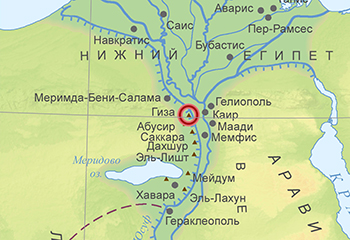
- Region:
- Northeastern Africa
- Timespan:
- 30th — 4th centuries BC
- Coordinates:
- 29.98
31.13
GIZA — one of the main Memphite necropolises, situated on the west bank of the Nile River, now a suburb just South-West of Cairo


Fig. 1. Map of Ancient Egypt, with Main Urban Centres and Archaeological Sites

Fig. 2. Giza Necropolis. Aerial View.
Photo: © ARNIS SAMARINS / Shutterstock.com

Fig. 3. Plan of the Main Archaeological Sites of the Giza Plateau

Fig. 4. The Great Sphinx and the Pyramids of Khafre and Menkaure in Giza.
Photo: © Daily Travel Photos / Shutterstock.com

Fig. 5. The Pyramids in Giza, South-West View.
Photo: © Fahed3339 / Shutterstock.com

Fig. 6. Mastabas of Priests and Officials in the Giza West Field.
Photo: © S. E. Malykh.
GIZA — one of the main Memphite necropolises, situated on the west bank of the Nile River, now a suburb just South-West of Cairo.
Name
Giza traces its name to an Arabic toponym ‘El-Giza’, after a 7th century AD settlement (Arabic ‘el-Gīza’).
Chronology
Most of the sites here date back to the peak of the Old Kingdom (Dynasties IV–VI, 26th — early 22nd century BC). There are also isolated tombs, including so called Covington’s tomb, dated to the Early Dynastic Period (30th–29th centuries BC) [Covington 1905; Petrie 1907: 2–8], First Intermediate Period [Malykh 2017], New Kingdom, and Late Period [Zivie-Coche 1991].
History of Scientific Exploration and Contemporary Researches
The study of Giza (Fig. 1) began in the first half of 19th century (Nestor L’Hote, a member of J.‑F. Champollion’s group, and later K. R. Lepsius, A. F. Mariette, and W. M. F. Petrie) [Lepsius 1897: 24–127; Mariette 1889: 488–571; Petrie 1883; 1907: 2–9; Lebedev 2018]. The systematic archaeological research of Giza started when the site was split into three concessions: German (L. Borchardt, W. Hoelscher, and later H. Junker and K. Kromer) [Junker 1929–1955; Kromer 1972; 1978; 1991], Italian (E. Schiaparelli), and American (G. A. Reisner, C. Fisher, W. Simpson, D. Dunham, E. Brovarski, P. Der Manuelian).
Outstanding finds, such as the cache tomb of Queen Hetepheres I, the mastaba of Queen Meresankh III, the mastaba of Seshemnefer III, and others, allowed to acquire information about the layout and architecture of the royal pyramid complexes, structure and decoration of the private tombs, their owners’ social status, and to form collections of objects that offer insight into the Egyptian material culture of the third millennium BC [Reisner 1931; 1942; Reisner, Smith 1955; Fisher 1924; Dunham, Simpson 1974; Der Manuelian 2009; Brovarski 2000].
From 1930s Egypt actively developed its national archaeology (S. Hassan, A. Fakhry, A.-M. Abu-Bakr). Excavations focused on the Central and Western Giza Plateau [Hassan 1932–1960; Abu-Bakr 1953; Handoussa, Brovarski 2021], also, the unearthing and conservation of Khufu’s Solar Boat, relocated at the moment to the Grand Egyptian Museum, were performed [Jenkins 1980].
The most important discoveries in South-Eastern Giza in the 1990s were the so-called ‘city of the pyramid builders’ dated to the Forth Dynasty by M. Lehner [Lehner 2002; Lehner, Wetterstrom 2007] and the ‘cemetery of the pyramid builders’ dated to the Forth — Fifth Dynasties by Z. Hawass [Hawass 2008].
Contemporary archaeological research in Giza is conducted by Egyptian, American, Japanese, and Russian teams. Japanese experts have completed the recovery of Khufu’s second boat from the hidden rock pit and started the conservation process. Egyptian archaeologists have initiated the demolition of Nazlet el-Samman village adjacent to the archaeological site and are currently clearing Khufu’s ‘ascending’ (processional) causeway and searching for his Valley Temple. Russian archaeologists are focused on researching rock-cut tombs of Eastern Giza and the surrounding ‘minor cemeteries’ [Kormysheva, Malykh 2010; Kormysheva et al. 2010; 2012; 2015; 2018; 2021].
Layout and Features
The archaeological site occupies a rock plateau formed by Eocene limestones of the Mokattam Formation, partially covered by the Libyan Desert sands (Fig. 2, 3). The core of the Giza Necropolis are pyramid complexes of the Forth Dynasty kings: Khufu, Khafre, and Menkaure (Fig. 2, 4, 5). The pyramids were constructed from the local limestone mined at the site (which is evidentially supported by the remnants of quarries at Khufu’s and Khafre’s pyramids) and cladded with transported materials (Tura limestone and Aswan granite). Royal complexes are surrounded by an extensive necropolis (circa 150 hectares) of royal relatives, high nobility, officials and priests of the middle and lower classes, and ordinary workers. This necropolis is located on the so-called West (Fig. 6), Central, and East Fields, Giza I South Cemetery (GIS Сemetery) and in South-Eastern Giza.
Apart from the pyramid itself, Giza royal pyramid complexes include mortuary (upper) and valley (lower) temples (Fig. 7), a processional road (causeway) connecting them, and royal barques burials. The extensive necropolises of the nobility that surround the pyramids clearly indicate the preliminary planning in the arrangement of Early Forth Dynasty mastabas at the Western and Eastern Giza plateaus and the GIS cemetery. The most common shape for a private tomb was an above-ground stone mastaba with a small cult chapel and modest relief decorations (‘Cheops style’) and one or two shafts leading to the burial chambers.
Subsequently clear areas of the necropolis were filled with high nobility mastabas and family tombs (with three and more burials), richly decorated with cult and daily life scenes. From the second half of Forth Dynasty, rock-cut tombs appear in Giza, some of which are located in the quarries. At the end of the Old Kingdom, due to the overall economic decline in Egypt, the most popular forms of Giza burials were mud brick mastabas and shaft burials, which formed the so-called minor cemeteries around large private mastabas [Simpson 1976; 1978; 1980; Roth 1995; Weeks 1994; Malykh 2014].
The New Kingdom and Late Period saw Giza’s Renaissance as a sacred space, when the Sphinx Temple (reign of Amenhotep II, 1438/36–1412 BC) and Temple of Isis [Hassan 1953; Zivie-Coche 1991] were erected. During the Late, Ptolemaic, and Roman Periods Giza tombs were used as secondary burials [Kormysheva et al. 2018; Malykh 2022]. During the Saite Period new shaft burials were cut into the Giza Central Plateau, and a separate necropolis, consisting of limestone block tombs, was built in the southern part of Giza.
The Giza Necropolis is a multi-layered archaeological site which, for a long time, also functioned as a settlement. Apart from the ‘city of the pyramid builders’ itself, dwellings of priests were discovered in the Valley Temple of Menkaure and to the south of it, and to the west of Khafre’s Pyramid workers’ ‘barracks’ were found [Reisner 1931: 49–54; Saleh 1974; Conard, Lehner 2001]. Many rock-cut tombs on the eastern edge of Giza were used as living quarters during the Medieval and modern times. In the 19th century some of them became temporary dwellings of the early explorers, such as G. B. Caviglia, H. Vyse, N. L’Hôte, A. Mariette, and W. M. F. Petrie [Lebedev 2020a; 2020b].
Archaeological Finds
The objects discovered at the site date from the Early Dynastic Period to the modern era. Those that relate to the Old Kingdom are associated with burial rites and mortuary cults, and include ceramic and stone vessels and their miniature models, stone and copper tools and their models, jewellery and amulets made of faience, copper, semiprecious stones, gold and silver, wooden furniture and stone headrests. Later objects dated from the 1st millennium BC to 2nd millennium AD include household ceramics, glass, faience, porcelain and bronze vessels, iron tools, smoking pipes, and various coins (dated from Ptolemaic Period to the present) [Malykh 2018; 2020; Goncharov, Malykh 2020; 2021].
The Giza Necropolis is significant for the study of the material culture of Ancient Egypt, its funeral rites and mortuary cults. Throughout the years, the pyramids, clearly visible from the distance and easily accessible, were a subject of widespread plundering. In the nowadays, the proximity of the metropolis, touristic activity and climatic changes are adversely affecting the site.
_cr.jpg)
Fig. 7. Upper (Mortuary) Temple of Menkaure, Giza.
Photo: © Stock Photos 2000 / Shutterstock.com
Bibliography
Abu-Bakr 1953 — Abu-Bakr, A.-M. Excavations at Giza 1949–1950. Cairo: Government Press, 1953. Brovarski 2000 — Brovarski, E. Giza Mastabas. Vol. 7. The Senedjemib Complex. Part 1. The Mastabas of Senedjemib Inti (G 2370), Khnumenti (G 2374), and Senedjemib Mehi (G 2378). Boston: Museum of Fine Arts, 2000. Conard, Lehner 2001 — Conard, N. J., and M. Lehner. “The 1988/1989 Excavation of Petrie’s ‘Workmen’s Barracks’ at Giza.” Journal of the American Research Center in Egypt, vol. XXXVIII, 2001, pp. 21–60. Covington 1905 — Covington, D. “Mastaba Mount Excavations.” Annales du Service des Antiquités de L’Égypte, t. 6, 1905, pp. 193–218. Der Manuelian 2009 — Der Manuelian, P. Giza Mastabas. Vol. 8. Mastabas of Nucleus Cemetery G 2100. Part 1. Major Mastabas G 2100–2220. Boston: Museum of Fine Arts, 2009. Dunham, Simpson 1974 — Dunham, D., and W. K. Simpson. Giza Mastabas. Vol. 1. The Mastaba of Queen Mersyankh III. Boston: Museum of Fine Arts, 1974. Fisher 1924 — Fisher, C. S. The Minor Cemetery at Giza. Philadelphia: University Museum, 1924. Goncharov, Malykh 2020 — Goncharov, E. Yu., and S. E. Malykh. “Islamskie monety iz Vostochnoĭ Gizy (Egipet)” [Islamic Coins from Eastern Giza]. Vestnik Instituta vostokovedeniia RAN [Journal of the Institute of Oriental Studies RAS], no. 3, 2020, pp. 57–62 (in Russian). Goncharov, Malykh 2021 — Goncharov, E. Yu., and S. E. Malykh. “Antichnye monety iz raskopok Rossiĭskoĭ arkheologicheskoĭ ėkspeditsii IV RAN v Gize (Egipet)” [Antique Coins from the Excavations of the Russian Archaeological Mission of the Institute of Oriental Studies RAS at Giza (Egypt)]. Vestnik Instituta vostokovedeniia RAN [Journal of the Institute of Oriental Studies RAS], no. 3, 2021, pp. 144–151 (in Russian). Handoussa, Brovarski 2021 — Handoussa T., and E. Brovarski. The Abu Bakr Cemetery at Giza. Atlanta: Lockwood Press, 2021. Hassan 1932–1960 — Hassan, S. Excavations at Giza. Vol. I–X. Oxford, Cairo: Government Press, 1932–1960. Hawass 2008 — Hawass, Z. The Builders of the Pyramids. Cairo: Nahdet Misr, 2008. Jenkins 1980 — Jenkins, N. The Boat beneath the Pyramid: King Cheops’ Royal Ship. New York: Holt, Rinehart and Winston, 1980. Junker 1929–1955 — Junker, H. Giza. Bd. I–XII. Wien, Leipzig: Hölder–Pichler–Tempsky, 1929–1955. Kormysheva, Malykh 2010 — Kormysheva, E., and S. Malykh. “Lepsius Tombs in Giza Necropolis re-discovered.” Journal of Egyptian Archaeology, vol. 96, 2010, pp. 49–70. Kormysheva et al. 2010 — Kormysheva, E., S. Malykh, and S. Vetokhov. Giza. Eastern Necropolis I. The Tomb of Khafraankh. Moscow: IOS RAS, 2010. Kormysheva et al. 2012 — Kormysheva, E., S. Malykh, and S. Vetokhov. Giza. Eastern Necropolis II. The Minor Cemetery to the East from the Tomb G 7948. Moscow: IOS RAS, 2012. Kormysheva et al. 2015 — Kormysheva, E., S. Malykh, M. Lebedev, and S. Vetokhov. Giza. Eastern Necropolis III. Tombs of Tjenty II, Khufuhotep, and Anonymous Tombs GE 17, GE 18, GE 47, GE 48, and GE 49. Moscow: IOS RAS, 2015. Kormysheva et al. 2018 — Kormysheva, E., S. Malykh, M. Lebedev, and S. Vetokhov. Giza. Eastern Necropolis IV. Tombs of Perseneb, Ipy, and Anonymous Tombs GE 23, GE 40, GE 56, GE 57, and GE 58. Moscow: IOS RAS, 2018. Kormysheva et al. 2021 — Kormysheva, E., S. Malykh, M. Lebedev, and S. Vetokhov. Giza. Eastern Necropolis V. Tombs of Perinedju and Nefersefekhptah. Moscow: IOS RAS, 2021. Kromer 1972 — Kromer, K. Österreichische Ausgrabungen in Giseh (VAR). Vorberichtüber die Frühjahrskampagne 1971. Wien: Hermann Böhlaus Nachf, 1972. Kromer 1978 — Kromer, K. Siedlungsfunde aus dem frühen Alten Reich in Giseh. Österreichische Ausgrabungen 1971–1975. Wien: Verlag der Österreichischen Akademie der Wissenschaften, 1978. Kromer 1991 — Kromer, K. Nezlet Batran. Eine Mastaba aus dem Alten Reich bei Giseh (Ägypten). Österreichische Ausgrabungen 1981–1983. Wien: Verlag der Österreichischen Akademie der Wissenschaften, 1991. Lebedev 2018 — Lebedev, M. A. “Franko-toskanskaia ėkspeditsiia v Gize (Egipet): novye dannye” [Franco-Tuscan Expedition in Giza: New Evidence]. Vestnik Instituta vostokovedeniia RAN [Journal of the Institute of Oriental Studies RAS], no. 3, 2018, pp. 53–64 (in Russian). Lebedev 2020a — Lebedev, M. A. “‘Groty’, ‘katakomby’ i ‘peshchery’ u egipetskikh piramid: svidetelʹstva o skalʹnykh grobnitsakh Gizy v rabotakh rannikh puteshestvennikov (XII–XVIII vv.) [“Grottos”, “Catacombs”, and “Caves”: Data on Giza Rock-Cut Tombs in Works of Early Travelers (12th–18th Centuries)]. Vestnik Instituta vostokovedeniia RAN [Journal of the Institute of Oriental Studies RAS], no. 2, 2020, pp. 146–159 (in Russian). Lebedev 2020b — Lebedev, M. A. “Dzh. B. Kavilʹia i nachalo arkheologicheskogo izucheniia skalʹnykh grobnits vostochnoĭ okrainy Gizy” [G. B. Caviglia and the Beginning of Archaeological Studies of Rock-Cut Tombs of the Eastern Escarpment of Giza]. Vestnik Instituta vostokovedeniia RAN [Journal of the Institute of Oriental Studies RAS], no. 3, 2020, pp. 63–76 (in Russian). Lehner, Wetterstrom 2007 — Lehner, M., and W. Wetterstrom (eds.). Giza Reports: Giza Plateau Mapping Project. Vol. 1. Boston: AERA, 2007. Lehner 2002 — Lehner, M. “The Pyramid Age Settlement of the Southern Mount at Giza.” Journal of the American Research Center in Egypt, vol. XXXIX, 2002, pp. 27–74. Lepsius 1897 — Lepsius, C. R. Denkmäler aus Aegypten und Aethiopien. Text. Bd. I. Unteraegypten und Memphis. Leipzig: J. C. Hinrichs’sche Buchhandlung, 1897. Malykh 2014 — Malykh, S. E. “Shakhty s neskolʹkimi pogrebalʹnymi kamerami: problema funktsionirovaniia Gizekhskogo nekropolia v ėpokhu Drevnego tsarstva” [Shafts with Several Burial Chambers: The Problem of Functioning of Giza Necropolis During the Old Kingdom]. Vestnik drevneĭ istorii [Journal of Ancient History], no. 4, 2014, pp. 3–19 (in Russian). Malykh 2017 — Malykh, S. E. “Funktsionirovanie Vostochnogo nekropolia Gizy v kontse Drevnego tsarstva i Pervom Perekhodnom periode” [Functioning of the Eastern Necropolis of Giza at the End of the Old Kingdom and the First Intermediate Period]. Vestnik drevneĭ istorii [Journal of Ancient History], no. 3, 2017, pp. 537–554 (in Russian). Malykh 2018 — Malykh, S. E. “Keramika Gizy kak indikator khronologicheskoĭ mnogosloĭnosti arkheologicheskogo pamiatnika Egipta” [Giza Pottery as an Indicator of the Chronological Multilayeredness of the Egyptian Archaeological Site]. Vestnik Instituta vostokovedeniia RAN [Journal of the Institute of Oriental Studies RAS], no. 2, 2018, pp. 164–178 (in Russian). Malykh 2020 — Malykh, S. E. “Keramicheskie trubki-ottomanki iz Gizy: k istorii tabakokureniia na Vostoke” [Ceramic Pipes-Ottomans from Giza: On the History of Tobacco Smoking in the Orient]. Vestnik Instituta vostokovedeniia RAN [Journal of the Institute of Oriental Studies RAS], no. 3, 2020, pp. 77–89 (in Russian). Malykh 2022 — Malykh, S. E. “‘Taĭniki balʹzamirovshchikov’ v vostochnoĭ Gize: k istorii vtorichnogo ispolʹzovaniia drevneegipetskikh grobnichnykh kompleksov ėpokhi Drevnego tsarstva v I tys. do n. ė.” [“Embalming Caches” in Eastern Giza: Towards the History of Secondary Use of Ancient Egyptian Old Kingdom Burial Complexes in the First Millennium BC]. Vestnik drevneĭ istorii [Journal of Ancient History], no. 2, 2022, pp. 281–302 (in Russian). Mariette 1889 — Mariette, A. Les Mastaba de l’Ancien Empire. Paris: F. Vieweg, 1889. Petrie 1907 — Petrie, W. M. F. Gizeh and Rifeh. London: British School of Archaeology in Egypt, B. Quaritch, 1907. Petrie 1883 — Petrie, W. M. F. Pyramids and Temples of Gizeh. London: Field & Tuer, 1883. Reisner 1931 — Reisner, G. A. Mycerinus. The Temples of the Third Pyramid at Giza. Cambridge: Harvard University Press, 1931. Reisner 1942 — Reisner, G. A. A History of the Giza Necropolis. Vol. I. Cambridge: Harvard University Press, 1942. Reisner, Smith 1955 — Reisner, G. A., and W. S. Smith. A History of the Giza Necropolis. The Tomb of Hetep-heres the Mother of Cheops. Vol. II. Cambridge: Harvard University Press, 1955. Roth 1995 — Roth, A. M. Giza Mastabas. Vol. 6. A Cemetery of Palace Attendants. Boston: Museum of Fine Arts, 1995. Saleh 1974 — Saleh, A.-A. “Excavations Around Mycerinus Pyramid Complex.” Mitteilungen des Deutschen archäologischen Institut, Abteilung Kairo, Bd. 30, no. 1, 1974, S. 131–154. Simpson 1976 — Simpson, W. K. Giza Mastabas. Vol. 2. The Mastabas of Qar and Idu. Boston: Museum of Fine Arts, 1976. Simpson 1978 — Simpson, W. K. Giza Mastabas. Vol. 3. The Mastabas of Kawab, Khafkhufu I and II. Boston: Museum of Fine Arts, 1978. Simpson 1980 — Simpson, W. K. Giza Mastabas. Vol. 4. Mastabas of the Western Cemetery. Part 1. Boston: Museum of Fine Arts, 1980. Weeks 1994 — Weeks, K. R. Giza Mastabas. Vol. 5. Mastabas of Cemetery G 6000. Boston: Museum of Fine Arts, 1994. Zivie-Coche 1991 — Zivie-Coche, C. M. Giza au premier millenaire. Autour du temple d’Isis Dame des pyramides. Boston: Museum of Fine Arts, 1991.